The Tomb of Cecilia Metella on the Appian Way
Few places along the Appian Way in Rome capture the atmosphere of ancient Rome as powerfully as the Tomb of Cecilia Metella. Standing beside the ancient Roman road for more than two thousand years, this monumental mausoleum remains one of the most iconic landmarks along the Via Appia Antica.
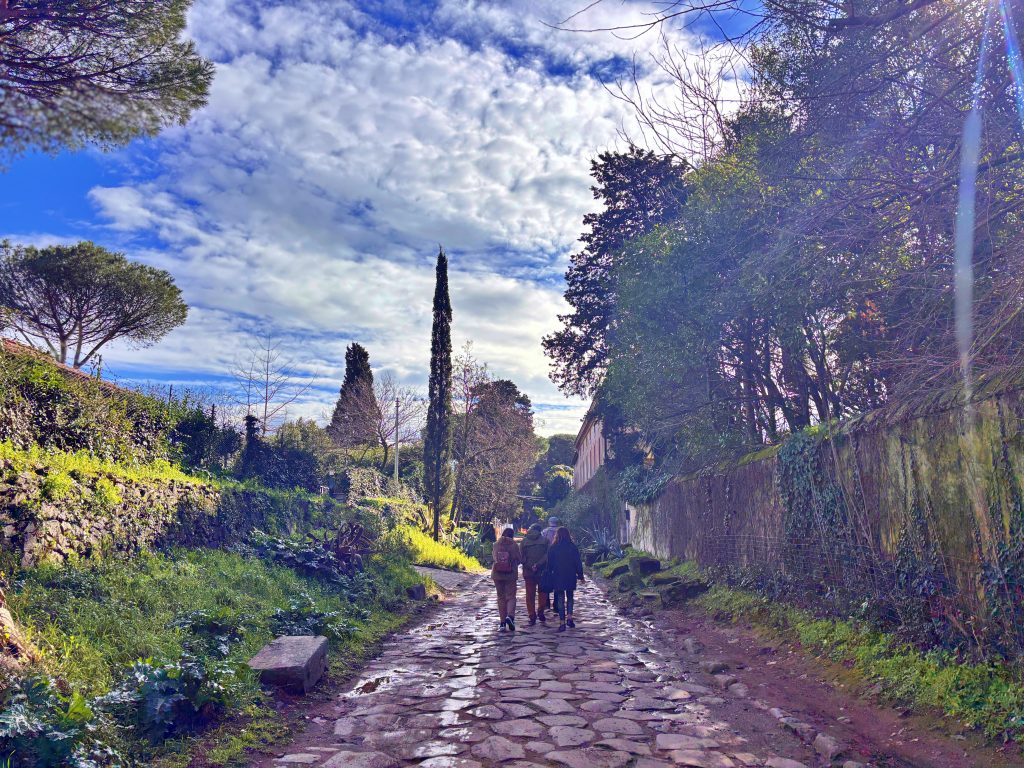
Standing above the ancient basalt road for more than two thousand years, this massive circular mausoleum has watched armies, pilgrims, merchants and travelers pass by since the late Roman Republic. Even today, surrounded by umbrella pines, open countryside and the silence of the Via Appia Antica, it remains one of the most iconic monuments outside the historic center of Rome.
For many visitors walking along the ancient road, the tomb becomes one of the most memorable moments of the entire experience.
If you would like to understand the wider history of this extraordinary road, you can also explore our complete guide to The Appian Way in Rome.
Who Was Cecilia Metella?
Cecilia Metella belonged to one of the most powerful aristocratic families of ancient Rome.
She was the daughter of Quintus Caecilius Metellus Creticus, a Roman consul and military leader during the 1st century BC. Her family commissioned this monumental tomb along the Appian Way, the most important road of the Roman Republic.
At the time, building a mausoleum beside the Via Appia was not only a funerary tradition, but also a public display of prestige, influence and political power.
The Appian Way connected Rome with southern Italy and was one of the busiest routes leading into the capital. Thousands of travelers passed here every day, making it the perfect place for elite Roman families to showcase their legacy.
Why Is the Tomb So Impressive?
The structure is enormous.
Built on a square base and crowned by a massive cylindrical tower, the mausoleum resembles a fortress rising above the ancient road. Originally, it was covered in travertine marble and richly decorated with sculptural details.
One of its most recognizable decorative elements is the marble frieze featuring ox skulls and garlands, symbols connected with Roman funeral rituals. These details are still visible today.
Even after centuries of transformations, wars and earthquakes, the monument continues to dominate the surrounding landscape.
Unlike many archaeological sites hidden within the dense urban fabric of central Rome, Cecilia Metella stands in an open environment where history and nature still coexist. This unique atmosphere is part of what makes the Appian Way feel so different from the rest of the city.
From Roman Mausoleum to Medieval Fortress
During the Middle Ages, the monument changed dramatically.
The powerful Caetani family transformed the tomb into part of a fortified castle complex controlling this strategic section of the Appian Way. Defensive walls, towers and military structures were added around the original Roman mausoleum.
Walking through the area today, visitors can still recognize this fascinating combination of ancient Roman engineering and medieval military architecture.
This layered history is one of the reasons why the Via Appia Antica remains one of the most fascinating places to explore in Rome.
Walking the Appian Way Today
During the Middle Ages, the monument changed dramatically.
The powerful Caetani family transformed the tomb into part of a fortified castle complex controlling this strategic section of the Appian Way. Defensive walls, towers and military structures were added around the original Roman mausoleum.
Walking through the area today, visitors can still recognize this fascinating combination of ancient Roman engineering and medieval military architecture.
This layered history is one of the reasons why the Via Appia Antica remains one of the most fascinating places to explore in Rome.
A Different Side of Rome
The Tomb of Cecilia Metella reminds us that Rome is much more than its famous city center.
Beyond the crowded piazzas and tourist routes, another Rome still survives: ancient, green, quiet and deeply connected to history.
For travelers looking for a more authentic and immersive experience, the Appian Way offers one of the most fascinating walks in the city.
Yes. The Tomb of Cecilia Metella is considered one of the most important and best-preserved monuments along the Appian Way. Its combination of Roman history, monumental architecture and surrounding natural landscape makes it one of the highlights of the Via Appia Antica including an amazing Virtual Reality experience!
The tomb was built during the 1st century BC, more than 2,000 years ago, during the late Roman Republic.
The monument is located along the Via Appia Antica (Appian Way), just outside the historic center of Rome, inside the Appia Antica Regional Park.
Yes. Walking is one of the best ways to experience the Appian Way and reach Cecilia Metella. The route allows visitors to fully appreciate the ancient paving stones, tombs, ruins and landscapes surrounding the monument.
Related Readings
Bereit, die Via Appia in Rom zu erleben?
Begleiten Sie einen Spaziergang in kleiner Gruppe durch die römische Landschaft und entdecken Sie eine der eindrucksvollsten Landschaften des antiken Rom.